
There’s a moment many would-be hikers and campers know well.
You love the idea of being outside.
You crave quiet trails, fresh air, and the feeling of moving through nature on your own terms.
And yet, when it comes time to actually go alone, hesitation creeps in.
Not because you’re incapable.
Not because you don’t belong out there.
But because starting something unfamiliar, especially solo, wakes up a very human kind of fear.
If that’s you, here’s the truth most outdoor advice skips: you don’t need to be fearless to begin hiking or camping alone. You just need a way to start that respects your nervous system, your pace, and your real life.
Fear Is Not a Sign You Shouldn’t Go
A lot of beginner hiking and camping advice frames fear as something to “push through” or conquer. That mindset sounds tough, but it often backfires.
Fear isn’t weakness.
It’s information.
When you’re new to hiking or camping alone, your brain is doing its job: scanning for uncertainty, risk, and unfamiliar variables. Ignoring that response doesn’t make you brave; it makes you overwhelmed.
Confidence doesn’t come from pretending fear doesn’t exist.
It comes from learning how to move with it instead of letting it run the show.
Why Small Steps Matter More Than Big Adventures
Social media loves dramatic before-and-after stories: first hike ever, straight into a remote backcountry trail. That makes for great content, but it’s terrible advice for beginners.
Real confidence is built through small, repeatable experiences:
- Walking a familiar trail alone for 15 minutes
- Car camping before backcountry camping
- Turning around early and calling it a success
These steps may look modest, but they teach your body something critical: I can do this safely.
That lesson sticks far longer than any forced leap of bravery.
The Problem With Gear-First Advice
Another common trap is focusing entirely on gear. Yes, having the basics matters—but equipment alone doesn’t create confidence.
You can own the best boots, pack, and tent on the market and still freeze at the trailhead if your mind hasn’t caught up yet.
What’s usually missing isn’t gear, it’s permission:
- Permission to go slow
- Permission to leave early
- Permission to define success on your own terms
That’s why mindset and decision-making matter just as much as what you carry.
How Prompts Can Help You Start (and Keep Going)
One of the most effective ways to ease into hiking and camping is by using gentle prompts instead of rigid plans.
Prompts don’t tell you what you must do.
They offer a place to begin.
A good prompt might ask:
- Where do I already feel safe outdoors?
- What would “enough” look like today?
- What’s my simple exit plan if I need it?
These questions shift your focus from “Can I do this?” to “What feels doable right now?”
And that shift changes everything.
Why Repeatable Guidance Beats One-Time Motivation
Motivation fades. Confidence compounds.
That’s why tools designed for beginners work best when they’re repeatable, not one-and-done. The same prompt can mean something very different on your first solo hike than it does three months later.
Early on, “start where you feel safe” might mean a paved park trail.
Later, it might mean a longer loop you’ve already walked once.
The prompt stays the same.
You grow into it.
Hiking and Camping Alone Doesn’t Mean Doing It Unsupported
Solo doesn’t have to mean disconnected.
Letting someone know your plans, choosing well-traveled areas, hiking during daylight, and setting clear return times are all ways to build safety into your experience, without giving up independence.
The goal isn’t isolation.
It’s self-trust with support built in.
A Gentle Way to Begin
If you’re standing at the edge of wanting more time outdoors, but don’t want to pressure yourself into extremes, start with a structure that feels calm instead of demanding.
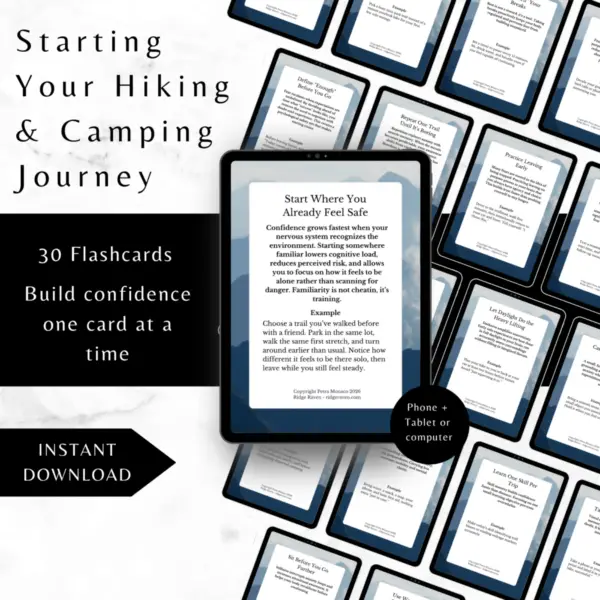
That’s exactly why I created Starting Your Hiking & Camping Journey, a digital prompt deck designed for beginners and hesitant solo hikers.
It includes:
- 30 fear-aware, confidence-building prompts
- Clear explanations (no “just be brave” nonsense)
- Practical examples you can use immediately
- Two PDF sizes for phone and computer use
You can pull one prompt before a hike, read it at the trailhead, or reflect afterward. There’s no finish line. No checklist to “complete.” Just guidance that meets you where you are.
You Don’t Have to Rush the Trailhead
The outdoors will still be there tomorrow.
You don’t need to prove anything.
You don’t need epic distances or dramatic stories.
You just need a starting point that feels honest.
Confidence isn’t built by going faster, it’s built by going again.
And the first step can be much smaller than you think.
Starting Your Hiking & Camping Journey
Starting Your Hiking & Camping Journey is a digital flashcard-style prompt deck designed for people who feel called to hike or camp, but feel hesitant doing it alone.

Leave a Reply